
3 Franklin College of Arts and Sciences professors receive NSF CAREER Awards
3 Franklin College of Arts and Sciences professors receive NSF CAREER Awards
Originally published by UGA Franklin College, written by Eliza Noe
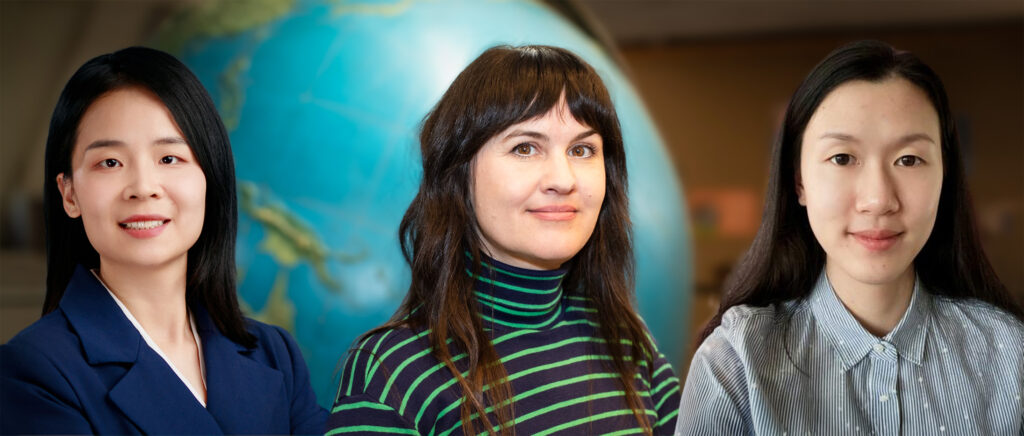
Three professors in the Franklin College of Arts and Sciences have received National Science Foundation CAREER Awards to fund research and community outreach.
Each year, the foundation recognizes about 500 early-career faculty who have displayed excellence in research and education. These faculty members have the potential to serve as academic role models in their careers, and their awards fund research, labs, equipment, and new educational opportunities for students, as well.
This year, faculty from the geology, statistics, and chemistry departments received the honor. In total, more than $1.9 million will support their innovative work, which ranges from geoscience to medicine.
Charlotte Garing – Geology

Associate Professor Charlotte Garing, of the online Master of Science (M.S.) in Environmental Geology, will use her award to continue her research in discovering how water and other fluids move through and interact with rocks.
The research will combine advanced flow experiments with high-resolution X-ray imaging to capture 3-D changes in pore structure, fluid distribution, and mineral surfaces during dissolution. Because her research focuses on the foundational understanding of how fluid moves through the earth underground, Garing said the results can be used to improve modeling and simulations across the fields of geosciences and engineering. This includes groundwater quality, hydrogen storage, carbon capture, and critical mineral extraction.
As part of the research, Garing and her team will develop three-dimensional videos and an immersive virtual field experience of Tumbling Rock Cave in Scottsboro, Alabama. Garing said the activity will allow students to see subsurface reactions happening in the real world.
“When it’s on the surface, you see it — you can see a river flowing. When it’s underground, you don’t see anything anymore,” Garing said. “The cave is a cool way to see water going through, but you also see the precipitation and the dissolution because there’s stalactites and stalagmites. For a student, that’s a good way to get them really interested in earth science and understand the importance of mineral reactions in changing landscapes and impacting resources.”
Award: $737,228
Rongjie Liu – Statistics
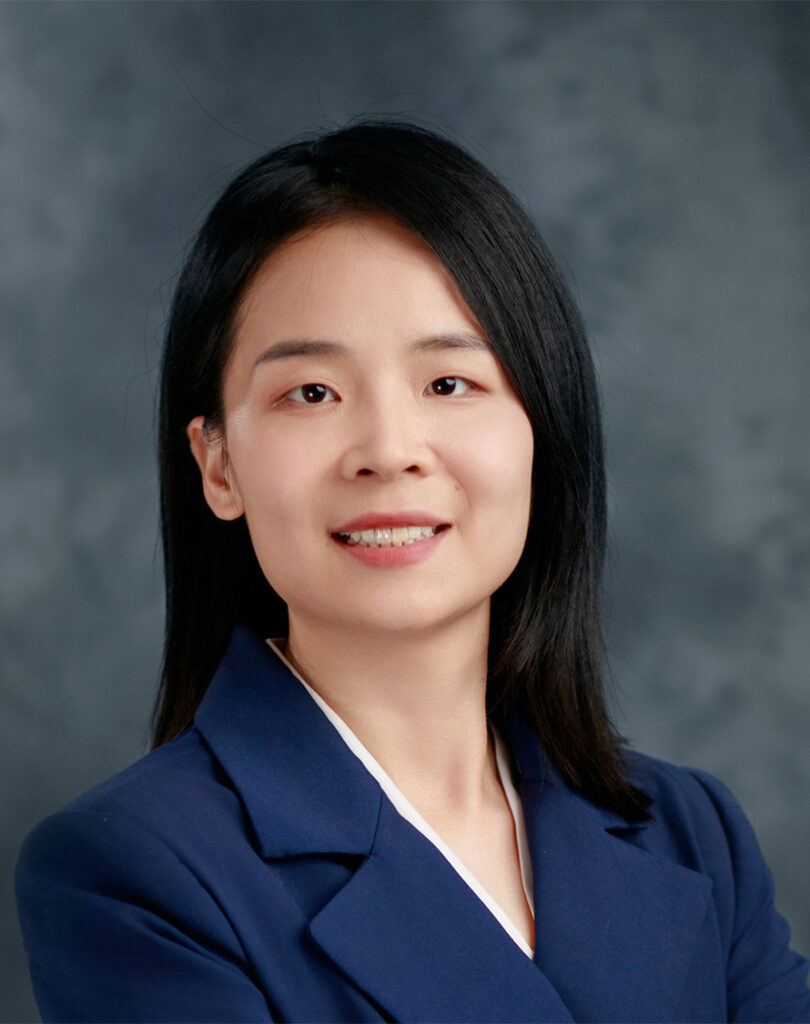
Associate Professor Rongjie Liu’s, of the online Master of Science (M.S.) in Applied Data Science, NSF CAREER project will develop new artificial intelligence and statistical learning methods to better understand complex neurological diseases.
Specifically, Liu said that her research group would use an integrated AI framework to bring together different types of medical data – including images, clinical records, and other patient information – to understand why a disease may develop and progress differently across individuals. Because neurological diseases behave differently from person-to-person, AI could help understand why those differences occur, she said.
Liu said that the long-term goal of the project is to create personalized disease management for patients, not just for those with neurological disease, but other complex health issues, as well. This could ultimately lead to earlier detection and better risk assessments for individual patients.
“For complex diseases, two patients with similar diagnoses may have very different biological characteristics, risk factors, and disease trajectories,” Liu said. “By integrating multiple sources of biomedical information and developing AI methods that can identify meaningful and potentially causal relationships, we hope to build models that can tell us not only what may happen to a patient but also provide insight into why it may happen.”
The award will also support several education and outreach opportunities, including AI and coding workshops for high school students, educational materials for other researchers and professionals, and research opportunities for undergraduate and graduate students.
Award: $546,167
Yifan Wang – Chemistry
Adjunct Assistant Professor Yifan Wang’s research focuses on understanding how enzymes perform unusual and highly selective chemical reactions. For her NSF CAREER project, her lab will study a family of cytochrome P450 enzymes that modify small peptides.
When enzymes are closely related, they can recognize similar or the same peptide substrates but perform very different reactions. Wang said knowing how enzymes choose which reaction occurs could help build a new foundation for engineering enzymes to make and modify complex molecules.
Wang said that the long-term goal of the research is to use enzymes as selective and sustainable catalysts for chemical synthesis. This creates new approaches for producing antibiotics, antitumor agents, and other valuable pharmaceuticals.
“Nature is an extraordinary chemist,” Wang said. “Enzymes can carry out difficult chemical transformations with remarkable precision, and even very similar enzymes can produce completely different outcomes. By understanding the molecular principles that govern this selectivity, we can learn not only how nature creates diverse molecules but also how we might eventually harness or redesign these biomachinaries.”
In addition to work in the lab, the project will integrate hands-on experiences and demonstrations for undergraduates, younger students, and the public to introduce enzyme chemistry in more accessible ways.
Award: $700,000