
News Articles
News Articles

The Maker Mindset and Learning by Design
June 17, 2026Gretchen Thomas, senior lecturer in the Department of Workforce Education and Instructional Technology with the University of Georgia’s Mary Frances Early College of Education, and an instructor in UGA’s online Educational Specialist (Ed.S.) in Learning, Design, and Technology – Instructional Technology program, understands that school can be stressful. So, she developed the service-learning course, EDIT 4100S - The Makerspace Class, that focuses on embracing what Thomas calls the “maker mindset.”

The chemistry of taste: Researchers seek the chemical clues that make a tasty peanut
May 29, 2026Originally published by UGA’s College of Agricultural and Environmental Sciences, written by Maria M. Lameiras Georgia grows more peanuts than any other state in the country. But for the breeders developing the next generation of varieties, some of the most consequential work isn’t happening in…

Javad Anjum named Fulbright U.S. Scholar to India
May 26, 2026Javad Anjum, an assistant professor in the Mary Frances Early College of Education's online Graduate Certificate in Pre-Professional Speech Language Pathology, was recently named a Fulbright U.S. Scholar to India for 2026-27.

Is a Graduate Degree Still Worth It in the Age of AI?
May 11, 2026Artificial intelligence is changing the way many people work, and for some professionals, that has sparked a bigger question: Is graduate school still worth it? For many reasons, across many fields, the answer is yes. Graduate school is about far more than acquiring information. It teaches students how…

Ralston Institute awards grants to advance behavioral health and developmental disability work
May 6, 2026The University of Georgia’s Ralston Institute for Behavioral Health and Developmental Disabilities has awarded its inaugural Momentum Grants in Behavioral Health and Developmental Disabilities, supporting interdisciplinary projects aimed at improving outcomes for individuals and families across Georgia.
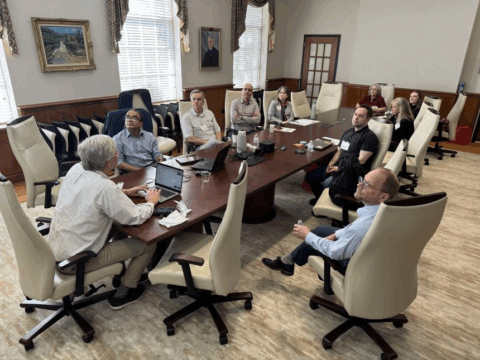
Inaugural Online M.S. in Applied Data Science Advisory Board Focuses on Industry Skills and Hiring Pipelines
April 22, 2026The Online Master of Science in Applied Data Science program at the University of Georgia brought together its inaugural advisory board on March 31, gathering faculty, industry leaders and UGA alumni in Athens for a day centered on industry trends, the data science skills gap, and how students can connect more directly with employers.

Lisa M. Renzi-Hammond announced Associate Dean of Outreach & Engagement
April 16, 2026Lisa M. Renzi-Hammond, faculty member in the online Graduate Certificate in Gerontology program, has been appointed as the University of Georgia College of Public Health’s Associate Dean of Outreach & Engagement.

Warnell launches online Master of Natural Resources, now enrolling for fall 2026
April 14, 2026The Warnell School of Forestry and Natural Resources at the University of Georgia is now accepting applications for its fully online Master of Natural Resources (M. N. R.), with classes beginning fall 2026.

Upcoming Virtual Info Sessions for UGA’s Learning, Design, and Technology Programs
April 13, 2026If you’re considering an online graduate program in Learning, Design, and Technology, these upcoming virtual information sessions are a great place to start. Each session offers a brief (40–60 minute) overview of the Ed.D. and M.Ed. programs with an emphasis in Instructional Design and Development. Sessions are held online and led by LDT faculty involved in the programs.

Julie Luft elected to chair education section of AAAS
April 9, 2026Julie A. Luft, the Athletic Association Professor of Science Education and Distinguished Research Professor in the Mary Frances Early College of Education, and faculty member in the online Master of Education (M.Ed.) in Science Education program, was recently elected to chair of Section Q, the education subgroup of the American Association for the Advancement of Science (AAAS).