
The Maker Mindset and Learning by Design
The Maker Mindset and Learning by Design

Originally published by the Office of Service Learning, written by Wes Mayer.
Gretchen Thomas, senior lecturer in the Department of Workforce Education and Instructional Technology with the University of Georgia’s Mary Frances Early College of Education, and an instructor in UGA’s online Educational Specialist (Ed.S.) in Learning, Design, and Technology – Instructional Technology program, understands that school can be stressful. So, she developed the service-learning course, EDIT 4100S – The Makerspace Class, that focuses on embracing what Thomas calls the “maker mindset.”
In addition to her work with makerspaces and service-learning, Thomas teaches in UGA’s online Educational Specialist (Ed.S.) in Learning, Design, and Technology – Instructional Technology program. Through the program, educators and learning professionals explore how instructional design, educational technology, and learner-centered experiences can be used to improve learning outcomes across schools, higher education, nonprofit organizations, and corporate training environments.

“The maker mindset is a disposition we all want our children to have,” Thomas said. “To be creative and persistent, to be critical thinkers and collaborators, and to be patient and share. This class is an opportunity to have a low-stakes environment and put this all into practice without knowing that they’re practicing. It’s an opportunity to exercise a skillset that is important regardless of subject area.”
EDIT 4100S connects UGA students with Clarke County School District students at Barrow Elementary School. Throughout the semester, Thomas’ students engage in project-based learning, first as learners themselves, then as mentors for students at Barrow, crafting artwork and playing around with new technology.
From learning how to knit with finger loops to learning how to code tiny robots, Thomas wants students to understand that it’s OK to explore and make mistakes without the pressure of grades.
“The students are so brilliant,” Thomas said, “and I want them to learn that it’s OK to mess up and not be evaluated for everything. Everything doesn’t have to have some level of stress.”

Thomas partners with Andy Plemmons, Barrow Elementary’s school library media specialist, who helps organize each session at the school’s Maker Space. Thomas said this course could not exist without Plemmons’ hard work and creativity as well as the support from Barrow Elementary staff.
UGA students visit Barrow twice a week on a consistent schedule, which helps build relationships with the elementary students. Barrow students can choose between recess or one of the sessions in the school media center, and Plemmons said about 40 join the sessions each week.
With the busy school day, he said it’s nice that students can tinker and explore without worrying about a polished final project, and he enjoys seeing them solve challenges on their own and discovering new skills with the support of Thomas’ students.
“They love UGA students,” Plemmons said. “There are quite a few who want mentors, and any time they can work with the community or with the college, it’s a big deal. This course especially has a wide range of UGA students from different majors as well as student athletes. Our students get to learn more about the college and what UGA students do outside of school as well.”
The class covers about eight projects over eight weeks, and this semester, the students started out with finger loop knitting, making buttons designed in Canva, folding origami and making masks for Barrow Elementary’s storybook parade, which was a highlight of the semester for many of Thomas’ students.

Later in the semester, the students explore more projects involving technology. This year, the students learned how to code Ozobots, play around with Makey Makey microcontrollers, and make some movie magic using green screens.
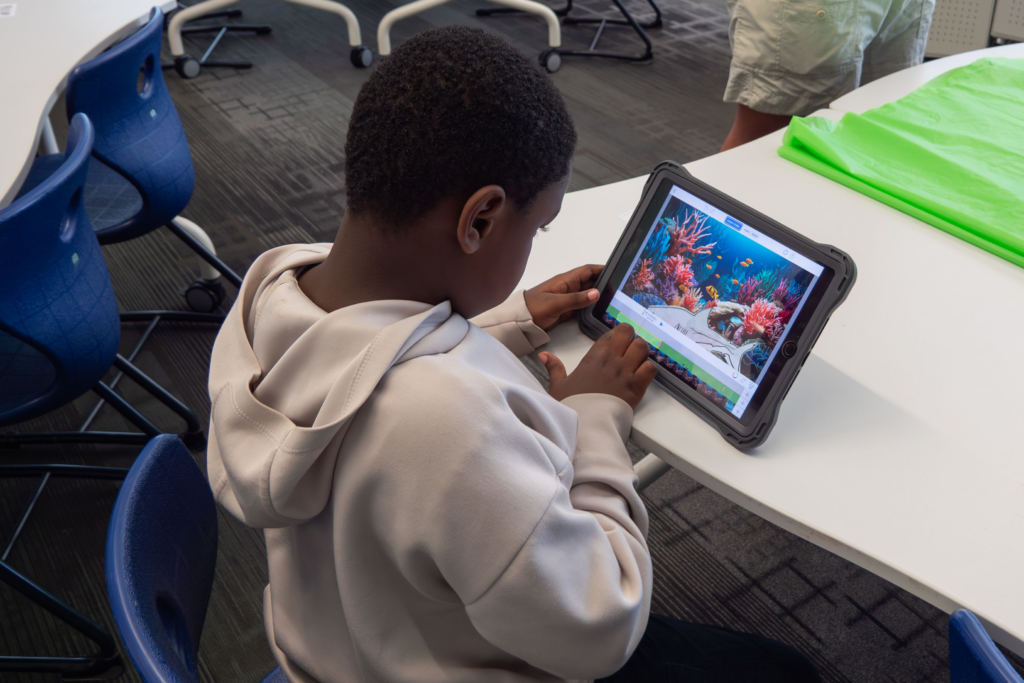
Barrow’s media center has most of the technology the students use in the sessions, but Thomas’ students bring some supplies, and she also wants her students to practice and play in class before heading to the elementary school. These supplies can add up, but support grants from the Office of Service-Learning help offset the cost and allow Thomas to explore new projects. This semester, the service-learning grants went toward buying fabric and materials to practice sashiko, the Japanese embroidery technique of clothing mending and decorating.
The course is open to all students who may be interested in working with younger learners. Being a service-learning course, it also satisfies UGA students’ experiential learning requirements, which makes it popular for those approaching graduation.
Neo Corsini, a fourth-year economics major from Lynchburg, Virginia, said he initially thought the course would be about teaching computers to younger students, but he was happy to learn it involved using Maker Spaces. He said his own elementary school had a Maker Space, and having this chance to go to class and have fun has really helped with stress in his senior year. “It’s my favorite class that I’ve taken in so long,” Corsini said.

Thomas centers her course around weekly reflections, an important aspect in service-learning because it connects the experience of service with academic learning and personal growth. Each week, Thomas ensures the class reflects on the previous session at Barrow and considers what worked well and where improvement as mentors or communicators could be made.
“The reflections showed me how I grew throughout the semester,” said Will Prosser, a fourth-year economics major from Raleigh, North Carolina. “When the semester started out, I was nervous and never knew how the elementary school students were going to be. But I was pleasantly surprised. Through the reflections, I grew to not be so worried, and I became more focused on how I could make it more fun for them. I could tell I was growing and learning from reflecting.”

For their final, Thomas has her students design and present their own personal maker project—a new idea to create something with younger students like those at Barrow. This semester, the class met for a tour of the new Creative Engagement Wing (CEW) in the Miller Learning Center to check out the resources in its Maker Space. Thomas’ students were encouraged to develop their final project using the CEW’s 3D printers, laser cutters, Cricut smart cutting machines, sewing and embroidery machines, and other equipment.
Madeline Erwin, a fourth-year student majoring in psychology with a minor in pharmaceutical and biomedical sciences from Calhoun, Georgia, took two sections of the course during her final year at UGA. She said it was important to learn how to be creative and try new things, and she can take what she’s learned into her future career.
“Going into a career in pharmaceutical sales, this translates to understanding that people respond better when they feel at ease,” Erwin said. “Whether it’s building trust with clients or working with others, creating that kind of environment can lead to better communication, stronger connections, and more openness.
“This course taught me that learning and growth don’t have to come from pressure. They can come from curiosity, creativity, and feeling safe to try something new without any repercussions.”
Thomas teaches in UGA’s fully online Educational Specialist (Ed.S.) in Learning, Design, and Technology – Instructional Technology program. The program prepares educators, instructional designers, trainers, and learning professionals to design effective learning experiences and lead technology-enhanced learning initiatives across a variety of settings.